| Drag-reduction and Antifouling coatings |
|
Drag-reduction and Antifouling Coatings
1. We focus on surface wetting behavior beyond nature, which means surface wetting properties that cannot be found in nature. They are: switchable wettability between (super)hydrophobicity and (super)hydrophilicity, switchable water/oil droplet adhesion between superhydrophobic pinning states and superhydrophobic rolling states, superoleophobicity at the air–solid interface or even under vacuum, and self-healing (super)amphiphobicity at the air–solid interface. 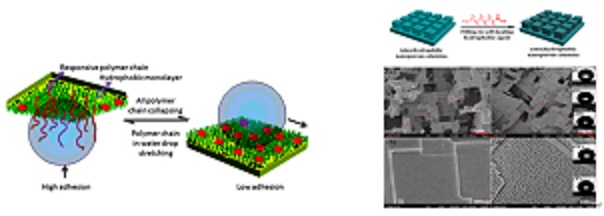 Figure 1. Left, Schematic illustration of mechanism on reversible adhesion of water droplets induced by macromolecular anchors on hydrophobic molecule modified Al2O3 Substrate. Right,Top: schematic depiction of a nanoporous alumina substrate and filling in hydrophobic perfluorooctyl acid. Bottom: SEM images of anodized alumina. 2. Boundary drag emerged when liquids flowed the solid surface, and this drag aroused many negative effects, such as energy-wasting, speed-reducing, especially in microfluidics and nanofluidic device. For basic research, base on surface modification, we have prepared many superomniphobic and responsive superhydrophobic surfaces and realized reversible controlled the adhesive force and slip length of water droplets when water flowed the surface. For application coating we try to fabricate various special purposed anti–drag coatings to reduce the fluid drag on ship and underwater vehicle.
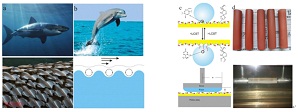
Figure 2. (a) the digital photo of shark and the microstructure of shark skin, (b) the digital photo of dolphin and the schematic of “fluid roller effect”, (c) schematic of superhydrophobic surface with the grafted temperature sensitive PNIPAM chains and the rheometer setup, (d) the anti–drag coating model and water tunnel test machine. 3. We are interested in the non-toxic solutions to marine biofouling. These approaches are mainly based on controlling the surface physicochemical, mechanical and topographic properties that have significant impacts on the interactions between marine organisms and the surface. Recently we worked on anti-fouling/fouling release surfaces made by biomimicking the patterns of natural leaves and modified with polymer brush. using surface engineering technologies to fabricate coatings with vary surface properties. 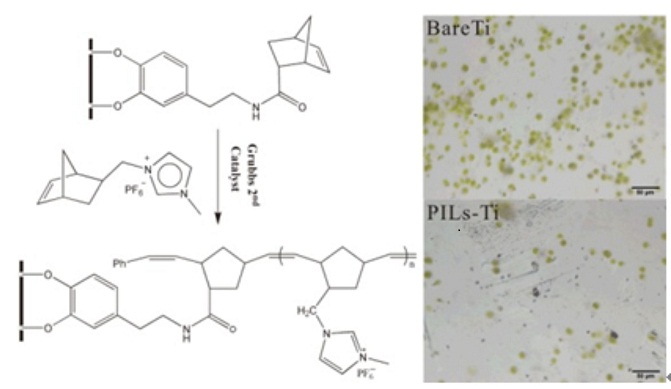
Figure 3. Grafting poly(ionic liquid) brushes for anti-bacterial and anti-biofouling applications. Meanwhile, marine biofouling is a costly, complex and environmentally harmful phenomenon which can cause the reduced ship speed and increased fuel consumption. Since the use of biocides is increasingly restricted by legislation, innovative antifouling solutions have to be developed. The aim of our work is to develop environmentally friendly antifouling coatings with projected long term performance. The approaches are mainly based on the extraction nature biocides from marine organisms and preparation of novel polymer as coating binders which combining the self-polishing, low surface energy properties and containing some antifouling active group in the polymer chains. We also interested in the accelerated laboratory test methods which can assess new products in a short time (<1 year). Furthermore, panels coated with experimental paints are exposed in the sea to determine their antifouling efficacy in practice. 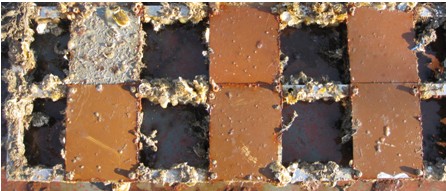 Figure 4. Experimental antifouling paints after 4 months immersion in seawater (Jul. 2011-Oct. 2011, Yellow Sea, Qingdao). 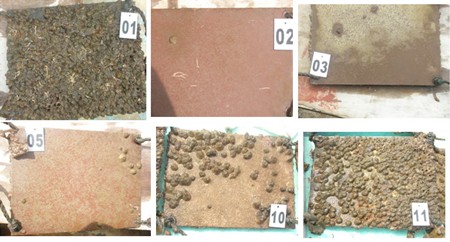
Figure 5. Experimental antifouling paints after 3 months immersion in seawater (Apr. 2012-Jul. 2012, South China Sea, Shenzhen).
Recent Publications: - Xinjie Liu, Yongmin Liang, Feng Zhou and Weimin Liu, Extreme wettability and tunable adhesion: biomimicking beyond nature? Soft Matter, 2012, 8, 2070-2086. DOI: 10.1039/C1SM07003G
- Qian Ye, Tingting Gao, Fei Wan, Bo Yu, Xiaowei Pei, Feng Zhou, Qunji Xue, Grafting poly(ionic liquid) brushes for anti-bacterial and anti-biofouling applications, J. Mater. Chem., 2012, DOI:10.1039/C2JM31527K
- Fei Wan, Xiaowei Pei*, Bo Yu, Qian Ye, Feng Zhou*, Qunji Xue, Grafting Polymer Brushes on Biomimetic Structural Surfaces for Anti-Algae fouling and Foul Release, 2012, ACS Appl. Mater. Interfaces, DOI: 10.1021/am300912w.
- Xiaolong Wang, Xinjie Liu, Feng Zhou, Weimin Liu, Self-healing superamphiphobicity, Chem. Comm., 2011, 47, 2324-2326. DOI:10.1039/C0CC04066E
- Xinjie Liu, Qian Ye, Bo Yu, Yongmin Liang, Weimin Liu, Feng Zhou, Switching Water Droplet Adhesion Using Responsive Polymer Brushes, Langmuir, 2010, 26, 12377-12382. DOI: 10.1021/la101909e
- Weici Wu, Xiaolong Wang, Daoai Wang, Miao Chen, Feng Zhou, Weimin Liu, Qunji Xue, Alumina nanowire forests via unconventional anodization and super-repellency plus low adhesion to diverse liquids, Chem.Comm., 2009, 1043-1045. DOI:10.1039/B818633B
|
|
|